Agentic Architecture: A Goal-Driven System
Understand AI agent architecture with a robot beekeeper story covering agentic loops, tool calls, memory, guardrails, multi-agent systems, and observability.
Quest for Healthier sweetner
TechFables wants a healthier sweetener for the coffee station.
So the team starts experimenting with a rooftop beehive - TechHive - beside a patch of wildflowers.
A live camera watches the hive and wildflowers.
Any staff member can ask, “How does the hive look?”
The assistant replies: “Bees are buzzing. Flowers need a manager.”
Useful, yes. But here is the catch:
Ask → Look → Answer → StopThe assistant only wakes up when you ask.
Otherwise, it goes back to daydreaming.
It can see the hive, but it is not watching over it.
Insight: No question, no answer — just daydreaming.
The caretaker: Nectar
Then a weekend heatwave hits. The camera sees the hive warming and the wildflowers curling, but the assistant is still daydreaming.
No ask. No action.
By Monday, the team is staring at a scorched flower patch and a stressed hive.
The assistant is just a brain locked away — a commentator with no hands.
TechHive does not need another commentator.
It needs a caretaker with hands, legs, and one clear goal: keep the colony healthy enough to make honey.
Enter Nectar.
Nectar is a small robot beekeeper with one goal: help TechHive make honey.
It is not just a better camera. It is a brain on wheels, connected to camera feeds, temperature sensors, humidity readings, soil moisture probes, and weather data.
More importantly, it has hands. It can open a ventilation flap, drip-water the wildflowers, lower a shade cover, and page the human beekeeper.
But the biggest upgrade is not the hardware.
The biggest upgrade is the goal itself.
The old assistant waited for a prompt; Nectar starts with a goal.
A prompt needs one answer. A goal needs follow-through.
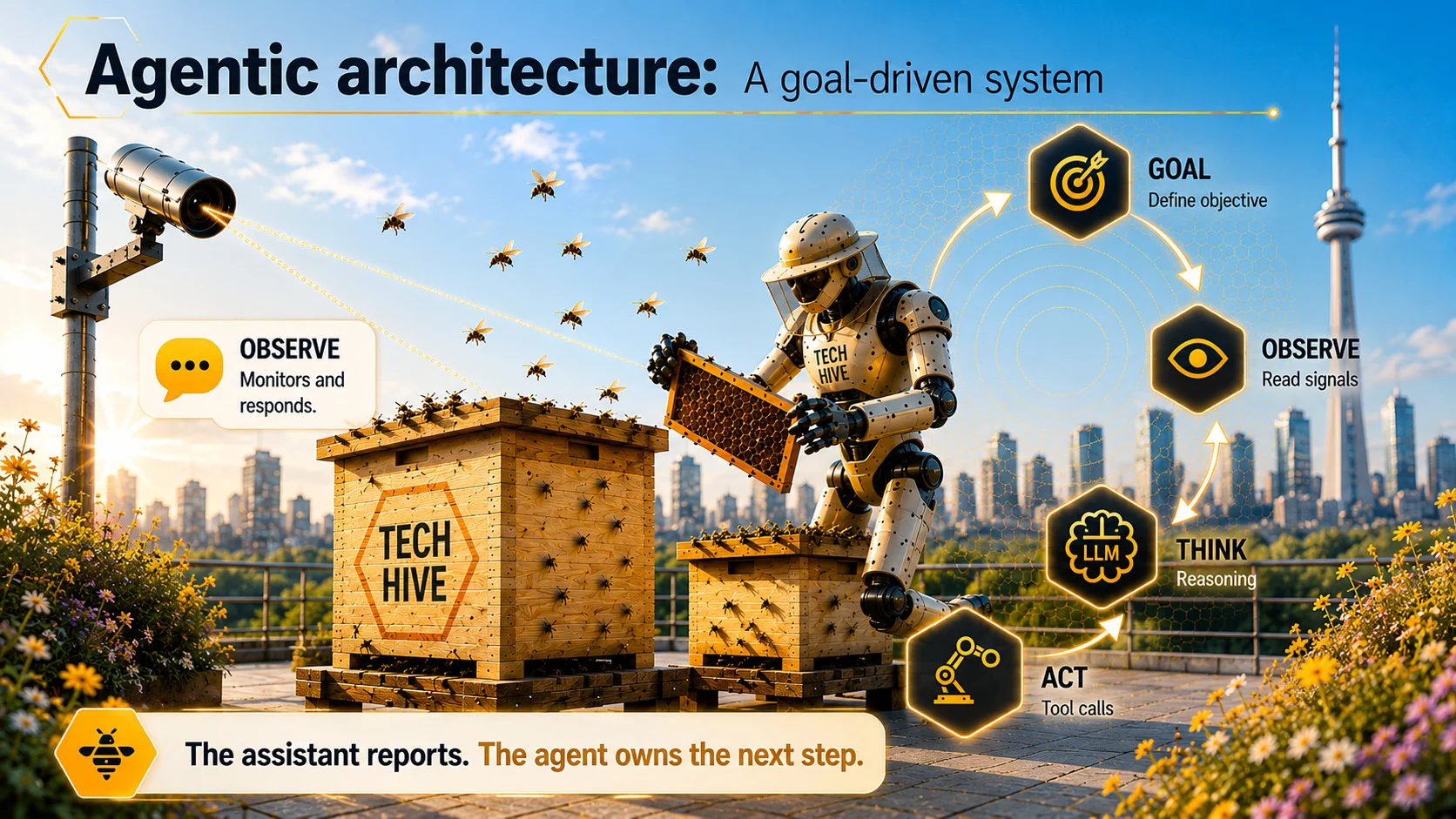
So the old assistant looked once, answered, and stopped; Nectar keeps coming back: watching for changes, reasoning through what they mean, taking the next action, and checking again.
That is the core of an AI agent:
An AI agent is a goal-driven system that observes its environment, reasons about the next step, acts through tools, and uses the result to decide what to do next.
The LLM is the brain, but the brain alone is not enough. Without a goal, it waits. Without tools, it only thinks. Without feedback, it never knows if anything worked.
Nectar needs all of it, so it runs a loop:
Goal → Observe → Reason → Act → Observe AgainWhen the flowers start drying out, the old assistant can joke:
“Flowers need a manager.”
Nectar says the same thing, grabs the caretaker hat, and gets to work.
It checks the soil, waters the patch, and keeps watching.
That is the difference: the assistant reports; the agent owns the next step.
The Agentic Loop
Nectar does not run once. It loops.
That is the whole point of an AI agent:
A normal assistant turns a question into an answer; an agent turns a goal into a loop.
Goal → Observe → Reason → Act → Observe AgainThe goal gives Nectar a reason to wake up before anyone asks:
Keep the colony healthy enough to make honey.
Observe: What Changed?
Observation gives Nectar the current state of the world: camera feed, hive temperature, humidity, soil moisture, weather, or the result of a previous action.
Reason and Plan: What Should Happen Next?
Reasoning is where the brain makes sense of the signals and plans the next move: Is the hive safe? Are the flowers drying out? Should Nectar act, wait, or call the beekeeper? If it chooses a tool, it also decides the details: open which vent, water which patch, alert which human?
Act: Execute the Tool
The brain does not physically open the vent. It asks for the action. The orchestrator executes the tool call, like opening a vent, lowering shade, watering flowers, scanning again, logging the event, or paging a human.
Observe Again: Did It Work?
After every action, Nectar checks the world again. Did the hive cool down? Did the soil improve? Did the action help or create a new problem?
That is the part that makes it agentic: the work does not end at “vent opened.”
Nectar checks what happened next, and that result becomes the next observation.
The cycle continues until the goal is safe, blocked, or needs a human.
The Architecture Behind the Loop
The agentic loop gives Nectar the recipe:
Observe → Reason → Act → Observe Again
But a recipe alone cannot open a vent, read a soil probe, remember the last action, or call the beekeeper.
To move from “thinking through the loop” to “running the loop in the real world,” Nectar needs supporting architecture:
- Tools: the hands that turn decisions into actions.
- Memory: the state that carries recent actions and results forward.
- Guardrails: the boundaries that decide when Nectar must stop and call a human.
- Observability: the trace that lets engineers inspect what happened and improve the next run.
Without this architecture, the loop is just a reasoning pattern.
With it, the loop becomes a working agent.
Let’s start with the hands: tool calls.
The Hands: Tool Calls
The heatwave strikes again.
But this time, TechFables has Nectar — always awake, always carrying one goal:
Keep TechHive healthy enough to make honey.
So when the heat starts rising, Nectar’s brain asks the first real question:
What can I do?
The answer is simple: cool the hive by opening the ventilation flap.
But “open the flap” is not one thing.
Nectar has to reason about the heat, decide that venting is the safest next move, choose a tool, pass the right details, and then check what happened.
This maps to two important ideas behind modern agents: ReAct and Toolformer.
Reasoning and Acting: ReAct
Nectar does not just decide once.
It reasons, acts, observes what happened, and reasons again.
For Nectar, that looks like:
Reason: The hive is getting too hot.
Act: Use a tool to open the ventilation flap.
Observe: The vent opened, but the temperature is still rising.
Reason: The vent was not enough. Try another tool or call the beekeeper.
That rhythm is ReAct (Reason + Act). Introduced in a foundational 2022 paper by researchers at Princeton and Google Brain, ReAct: Synergizing Reasoning and Acting in Language Models, it lets the model reason, act, observe, and update the next step.
Tool Use: Toolformer
Nectar also needs to know which tool can turn the decision into action.
Opening a vent, watering flowers, scanning the hive, and paging the beekeeper are different tools. The brain has to choose the right one, pass the right details, and read the result.
For Nectar, a tool request looks like this:
{
  "tool": "open_ventilation_flap",
  "arguments": {
    "vent_id": "rear_top",
    "amount_percent": 30
  }
}
That JSON-shaped request is a tool call.
It is Nectar saying: “Use this tool, with these details, and bring me back the result.”
This concept was formalized by Meta AI Research in their paper Toolformer: Language Models Can Teach Themselves to Use Tools, which demonstrated how language models learn when to call a tool, which tool to call, what details to pass, and how to use the result.
The Tool Menu
The engineering team registers Nectar’s tools so the LLM can see what actions are available.
Each tool is registered using a strict schema—a menu containing its name, a description, and the exact parameters it needs to run.
For example, the ventilation tool might be registered like this:
{
  "name": "open_ventilation_flap",
  "description": "Open a hive vent for airflow",
  "parameters": {
    "type": "object",
    "properties": {
      "vent_id": {
        "type": "string",
        "description": "Vent to open."
      },
      "amount_percent": {
        "type": "number",
        "description": "Open amount, 0–100."
      }
    },
    "required": ["vent_id", "amount_percent"]
  }
}
When Nectar chooses open_ventilation_flap, the orchestrator connects that request to the real system: robot hardware, an internal API, a database, a weather service, or a notification system.
Toolformer explains the model side: choosing the right tool and details.
The orchestrator explains the system side: running the real operation.
Together, the idea becomes:
Reason → Tool Call → Tool Result → Reason Again
The brain decides. The tool acts. The result comes back. The loop continues.
This is why tools are not a side feature of agents.
They are the difference between:
“The hive is hot.”
and:
“I opened the vent. Checking again in ten minutes.”
A chatbot describes the problem.
An agent calls the tool that starts fixing it.
The Logbook: Memory and State
Nectar observes the wildflowers curling again.
It checks the soil and reasons that the patch needs water.
So it makes a tool call and gives the roots a careful drink.
The tool result comes back: the patch was watered.
Then Nectar observes again: the flowers still look tired, and the top layer of soil still looks dry.
But that does not automatically mean: “Water again.”
Sometimes the smartest move is to wait. The soil needs time to soak it in.
Without state, Nectar cannot tell the difference between “needs water” and “already watered, wait.”
So it keeps watering.
Not because the brain is dumb.
Because the system forgot what just happened.
That is why Nectar needs a logbook: a short memory of recent actions, tool results, and cooldowns.
In Nectar’s logbook, the moment looks like this:
Action: water_wildflower_patch(duration=30)
Tool result: patch watered
Next observation: soil still absorbing water
Cooldown: wait before watering again
That logbook is state. It tells Nectar:
“This is not a brand-new dry patch. This is the same patch I just watered.”
When the agentic loop comes around again, the recent logbook is added to Nectar’s context window.
Now Nectar reads two things before choosing the next step: the current sensor data and what just happened.
Now it can reason with history, not just the latest sensor reading.
Insight: Tools help Nectar act.
Memory tells Nectar what it already did, so it knows when to wait.
Guardrails: SOS Human Beekeeper
It is another scorching afternoon on the TechFables rooftop. The hive temperature climbs.
Nectar opens the vent, waits, and checks again. Still too hot.
Nectar lowers the shade, waits, and checks again. Still too hot.
At this point, the next move is not another tool call. It is a human call.
Nectar pages the beekeeper:
“Hive temperature is still rising after ventilation and shade. Human review needed.”
That pause matters. That pause is the architecture working.
Nectar has not failed. It has reached the edge of its authority.
Opening vents and lowering shade are Nectar decisions.
What to do when they fail is a beekeeper decision.
So Nectar needs boundaries.
It needs to know the difference between “Safe for me” and “Time for a human.”
When Nectar pages the human, it is using a pattern called Human-in-the-Loop (HITL).
Nectar can handle low-risk actions on its own:
Open the vent.
Water the flowers.
Lower the shade.
But when the action becomes risky, uncertain, or irreversible, Nectar stops and pages the beekeeper.
Insight: The goal is not maximum autonomy. The goal is safe autonomy.
No boundaries, no caretaker — just a robot with bad judgment.
When One Agent Is Not Enough: The Swarm
The Nectar experiment works, so TechFables decides to expand into a full rooftop beehive garden.
Now there are more hives, more flowers, more sensors, and more things that can go wrong.
At first, one Nectar tries to handle it all.
But eventually, the work starts to split. The hive needs one kind of care. The garden needs another.
So TechFables creates two focused agents:
- Hive Agent: watches temperature, humidity, bee traffic, and ventilation.
- Garden Agent: watches soil moisture, flower health, sunlight, and watering.
Both agents serve the same larger goal:
Keep the colony healthy enough to make honey.
But they own different parts of the physical world.
If the Garden Agent sees the flowers drying out, it waters the patch.
If the Hive Agent sees bee traffic dropping, it checks the hive vents.
If both see trouble during a heatwave, they coordinate instead of stepping on each other.
Who Coordinates the Swarm?
There is no queen agent barking orders.
The Hive Agent and Garden Agent run their own loops, but they share the same rooftop logbook.
When the Garden Agent waters the flowers, it writes it down.
When the Hive Agent wakes up, it reads that note and avoids making decisions in the dark.
That shared state is how the swarm coordinates.
That is the useful idea behind a multi-agent system.
It is not one giant brain trying to do everything.
It is a small swarm of focused agents, each with its own job, tools, memory, and boundaries.
Insight: Do not build a swarm just because it sounds cool. Build one excellent caretaker first. Add another agent only when the work naturally splits.
The Tape: Observability and Evaluation
Imagine another scorching afternoon.
Instead of opening the ventilation flap, Nectar calls the wrong tool: water_wildflower_patch.
The flowers get soaked. The hive stays dangerously hot.
Why did Nectar choose the wrong tool?
That is why agents need observability and tracing.
Think of Nectar like a student taking a math exam who must “show the work.”
Nectar meticulously logs its process in a notebook: observations, tool calls, results, retries, and handoffs.
When Nectar makes a strange move, the engineers do not guess. They open the notebook and read the steps:
Observation: Hive temperature is 102°F.
Reason: Water cools things down, so watering flowers may help cool the bees.
Tool call: water_wildflower_patch(duration=60)
This tells the team why it happened — and what to improve next.
Insight: Tracing shows what happened. Evaluation shows what to improve next.
Together, they turn the black box into a glass box.
The Agentic Loop: Visualized
Agent Field Notes
Thermometer vs. Thermostat
A thermometer reports. A thermostat acts. The old assistant reports; Nectar acts.
Thermometer vs. Thermostat. A thermometer reports. A thermostat acts. The old assistant reports; Nectar acts.
Quiz
86% of people love quizzes after learning. Are you one of them?
Question text
Quiz complete